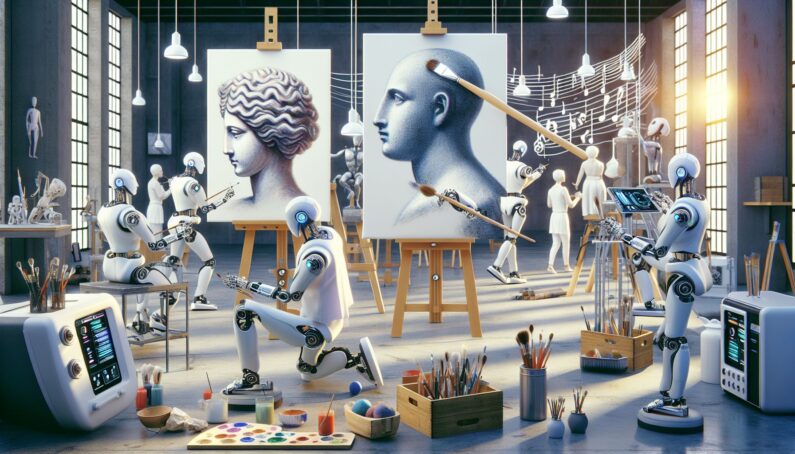
Hey tech enthusiasts! Get ready to dive into a world where Artificial Intelligence (AI) isn’t just crunching data or controlling autonomous cars, but is actually painting masterpieces and composing symphonies. Yep, today we’re talking about AI’s surprising role in creative arts. Spoiler alert: it’s not science fiction anymore, it’s happening right now, and it’s blowing minds across the globe.
A Personal AI Eureka Moment
So, let me start with a confession: my AI eureka moment wasn’t about some major discovery in a lab. It was while I was lazily browsing through art exhibits online. I stumbled upon a digital painting with such detail and emotion that for a moment, I thought it was the work of a talented human artist. Turns out, it was created by an AI called DALL-E. That’s when it hit me. AI isn’t just about algorithms anymore. It’s becoming a creative powerhouse.
AI’s Artistic Palette
How Does It Create?
You might wonder how machines can dabble in something as deeply human as art. It all comes down to Generative Adversarial Networks (GANs). Simply put, GANs are neural networks in a fun little game of competition. One network creates while the other evaluates, allowing them to progressively improve and produce incredible artistic work. Think of it like a digital canvas where AI gets to be both the artist and its toughest critic. This dynamic duo is behind some of the most impressive AI-generated art today.
The Canvas of Possibility
The implications are endless. Picture AI collaborating with artists across mediums, be it visual arts, poetry, or music. Artists like Taryn Southern have already teamed up with AI to create chart-topping tracks. Yes, folks, AI is officially a band member now. This isn’t just about automating art creation but also about expanding the horizons of creative expression itself.
Bridging the Old and New: AI Restorations
Breathing New Life into History
AI isn’t only making waves with new creations. It’s stepping into historic preservation. Gone are the days of painstakingly slow restoration projects. Instead, AI algorithms rapidly restore iconic artworks and artifacts, often with better accuracy than traditional methods. Needle in a haystack? More like pixels in an image. AI spots the blemishes invisible to the human eye.
Between Pixels and Brushstrokes
Consider this: AI has already reimagined Van Gogh’s lost paintings and filled in Beethoven’s unfinished symphonies. It’s as if our digital age gave Van Gogh and Beethoven a fresh brush or a restored piano to work with. The possibilities for educational and cultural enrichment are exciting, giving us new ways to connect with our past.
Who’s Leading the Dance?
The Big Players
OpenAI, Google Brain, and DeepMind come to mind when talking about AI innovation. But it’s not just the big guys. Startups like RunwayML and Artomatix are creating tools that democratize access to AI’s creative potential. Whether you’re a seasoned artist or an aspiring newbie, AI can be your new brush, your next chord, or your keen editor.
Learning the Moves
The best part? You don’t need a Comp Sci degree from MIT to make beautiful AI-powered art. The world of open-source tools and platforms brings this power to everyone. Platforms like GitHub host countless repositories, some of which can turn your laptop into a digital studio.
Debating Art: Creative or Calculative?
The Societal Skepticism
Here’s where the philosophical debates start. Is AI-produced art ‘real’ art? Critics argue that, devoid of consciousness or emotional experience, AI lacks the soul that fine art represents. Yet supporters maintain that art is a reflection of the times, and in this digital age, that reflection might just have a touch of machine in it.
Artistic Collaboration or Competition?
There’s also the question of jobs, an ever-familiar narrative when discussing AI. Will AI replace artists, or simply offer a new tool in their kit? From my perspective, I see it as a collaboration rather than a competition. It stretches the limits of what we consider creative acts. It’s tech and human working hand in hand, call it “techne” if you will.
The Future: From AI Musicians to Writers
Making a Mark on All Mediums
Beyond visual arts, AI is making its debut in literature and cinematography. In fact, there are already novels and scripts pieced together with neural networks. Films written by AIs might one day be a staple in our cinemas. Imagine a world where co-authors and co-directors might just have silicon instead of neurons.
Dare to Dream
Let’s speculate a bit: Could AI unlock forms of artistic expression we haven’t even conceived yet? Might art critiques one day evaluate how effectively AI and human elements merge in an artwork, much like critics currently debate form and style? I don’t have a crystal ball, but the prospects are fascinating.
Final Thoughts
So there you have it, a world where algorithms and art converge in a dance of bytes and brushstrokes. Whether you’re sipping your artisanal coffee while coding a generative art piece or simply absorbing the new digital masterpieces flooding social media, remember this: art is what we (or our digital brain children) make it. As we push the boundaries of creativity, we might just redefine the essence of art itself. And isn’t that a wild, wonderful thing?